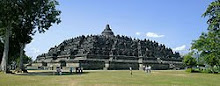
Between the end of the seventh and beginning of the eighth century A.D, Sanmaratungga was constructed Borobudur Temple and in 1814, Sir Thomas Stanford Raffles was revealed the ruined and buried Borobudur Temple. From 1905 to 1910, the temple was under the restoration and the last restoration was done in 1973 to 1983.
The structure of Borobudur Temple includes 55,000 square meters area, which is constructed on a hill and the shape of this temple is like a stepped-pyramid of six rectangular storeys, three circular terraces and a central stupa forming the summit. The whole structure of this temple is looks like a lotus, which is the sacred flower of Buddha.
The overall height of the temple was 42 meters, but after restoration only 34.5 meters of temple was revealed that had the dimension of 123 x 123 meters (15,129 square meters). The Borobudur Temple comprises10 floors and the first floor to the sixth floor were square form; the seventh to the tenth floor were round form.
Wednesday, December 10, 2008
Seven Wonders of the World

Tuesday, December 9, 2008
Borobudur & Prambanan
The province of Central Java, around the city of Jogyakarta, is the most famous part of Java and is, in fact, its cultural centre. This is in part because of the presence there of a variety of religious influences-Buddhist, Hindu, and other indigenous beliefs, which resulted in the construction of the impressive temples of Borobudur, Prambanan and the Dieng temple complex.
Borobudur Temple
The most famous of Indonesia's temples is this huge Buddhist pyramid. This is a Buddhism's largest shrine in Indonesia, built in the 9th century. Located north west of Jogyakarta, Borobudur was completed in the second half of the ninth century. Like the Hindu temple complexes Prambanan and the Dieng plateau, Borobudur was unknown and neglected for almost a thousand years, covered under thick layers of volcanic ash.
Perhaps the finest temple complex in Indonesia, Prambanan is a ten-century old Hindu temple. This temple is dedicated to the Hindu God Shiva, locally called Candi Loro Jonggrang, which means 'slender virgin.' From an architectural point of view this beautifully sculptured spire, fifty meters high, indeed resembles a 'slender virgin.' Like the Buddhist stupa Borobudur, Prambanan was abandoned when the Buddhist and Hindu Javanese inhabitants moved to East Java.
Monday, December 8, 2008
The Borobodur Temple complex is one of the greatest monuments in the world.

Buddhist marvel of stone standing in the garden of Java, Indonesia
The Borobodur Temple complex is one of the greatest monuments in the world. It is of uncertain age, but thought to have been built between the end of the seventh and beginning of the eighth century A.D. For about a century and a half it was the spiritual centre of Buddhism in Java, then it was lost until its rediscovery in the eighteenth century.
The structure, composed of 55,000 square meters of lava-rock is erected on a hill in the form of a stepped-pyramid of six rectangular storeys, three circular terraces and a central stupa forming the summit. The whole structure is in the form of a lotus, the sacred flower of Buddha.

One of the ninety-two Dhyani Buddha statues enclosed in stupas
For each direction there are ninety-two Dhyani Buddha statues and 1,460 relief scenes. The lowest level has 160 reliefs depicting cause and effect; the middle level contains various stories of the Buddha's life from the Jataka Tales; the highest level has no reliefs or decorations whatsoever but has a balcony, square in shape with round walls: a circle without beginning or end. Here is the place of the ninety-two Vajrasattvas or Dhyani Buddhas tucked into small stupas. Each of these statues has a mudra (hand gesture) indicating one of the five directions: east, with the mudra of calling the earth to witness; south, with the hand position of blessing; west, with the gesture of meditation; north, the mudra of fearlessness; and the centre with the gesture of teaching.

Devotional practice of circumambulate around the galleries and terraces.
Besides being the highest symbol of Buddhism, the Borobodur stupa is also a replica of the universe. It symbolises the micro-cosmos, which is divided into three levels, in which man's world of desire is influenced by negative impulses; the middle level, the world in which man has control of his negative impulses and uses his positive impulses; the highest level, in which the world of man is no longer bounded by physical and worldly ancient desire.
It is devotional practice to circumambulate around the galleries and terraces always turning to the left and keeping the edifice to the right while either chanting or meditating. In total, Borobodur represents the ten levels of a Bodhisattva's life which he or she must develop to become a Buddha or an awakened one.
Sunday, December 7, 2008
BOROBUDUR TEMPLE (overview 2)

The
The expression of experts who had been studying
Based on the inscription dated 842 AD, Casparis suggested that
The overall height was 42 meters, but was only 34.5 meters after restoration, and had the dimension of 123 x 123 meters (15,129 square meters). There were 10 floors. The first floor up to the sixth floor was square form, the seventh to the tenth floor were round form.
1. Structural Design of
Ever since the first excavation, most experts speculated on the exact shape of the temple. Hoenig, in his book “Das form problem des Borobudur” speculate that the original form of
According to Stutterheim, the overall form of
The relief of
Division of panels are: the first panel expressed a heavenly being in sitting position, on both side of this panel are small panel with a small standing statue. This figures are repeated 26 times for each side of the wall. Between the panels is carved three bodies, a male flanked by two women.
2. Relieves at the Walls of the Alley.
There was a long series of main relieves at the first alley, either at the main wall or at the inner side of Kutamara wall. Relieves at the Kutamara wall depicted Jataka's and Awadana's, a story of Buddha's life which expressed as Bodhisatwa, due to his good deeds in the past. Sometimes, Buddha is expressed in the form of animals such as rabbit, monkeys etc. As it was told in animated stories, the story was adopted from Sanskrit book, Jatakamala. Only one third of the relieves were known, the rest was still unclear.
The lower relieves of the main wall contained the same story. The upper relieves also had the same story as the lower one. The story contained the life of Buddha consisting of 120 frames until he began teaching Buddha religion. The first frame began from the South of stairway of the curved gate at the East, and follow the path of the sun (the temple on the right side). The life story of Buddha was adopted from Lalitawistara book.
At the second alley, Jataka and Awadana story were continued on the inner side of Utamara, and on the main wall, story was began with stories adopted from Gandhawyuha. This story was so long that it occupied the main wall and inner side wall of Utamara at the third and fourth alley. The story showed the adventure of a Sudhana who met Bodhisatwa Maytreya (the future Buddha) to have religious lesson from the Buddha. Later on, the Sudhana met with Bodhisatwa Mandjusri, and finally he met with Dyani Bodhisatwa Samanta Badra, who gave the highest wisdom. Most of those stories expressed the use of spiritual strength and unusual happenings.
There were many beautiful ornaments inscripted at the wall of the fourth alley, because the fifth alley did not contained any ornaments. The fifth alley is a transitional alley to the next platform, the round platform. The next round platforms also did not contained any ornaments at all (Kaylan,1959).
t temples. Thus the area under 235 meter altitude was below the lake water level.
Based on the inscription dated 842 AD, Casparis suggested that
The overall height was 42 meters, but was only 34.5 meters after restoration, and had the dimension of 123 x 123 meters (15,129 square meters). There were 10 floors. The first floor up to the sixth floor was square form, the seventh to the tenth floor were round form.
Saturday, December 6, 2008
Art and Architecture
In the period 600 AD to 800 AD there was a golden age of temple construction throughout India, Ceylon and South East Asia. It was a time when Hindu and Buddhist kingdoms flourished and men raised magnificent monuments to heaven in praise of their gods with a burst of frenetic activity of cultural expression and devotion. After their periods of glory they sank into oblivion, either as a result of military conquest or natural disasters and their monuments were reclaimed by the jungle and lost to mankind for almost a thousand years.
One of the most spectacular of these is the Buddhist temple of Borobudur that lies in Eastern Java on the Kedu Plain. It is surrounded by an idyllic landscape of incomparable beauty of rice-terraced hills and overlooked by four volcanoes. The industrious subjects of the Sailendra dynasty built it over a period of 80 years in the ninth century who transformed a volcanic plug of basalt into a stepped pyramid with a base measuring 120 metres square and a height of 35 metres.
Stupas at BorobudurIt was built to resemble a microcosm of the universe and its purpose was to provide a visual image of the teachings of the Buddha and show, in a practical manner, the steps through life that each person must follow to achieve enlightenment. The pilgrim to this shrine would first have been led around the base and shown the friezes, which illustrate the consequences of living in the World of Desire. In this realm ruled by Greed, Envy, and Ignorance, man is a slave to earthly desires and suffers from the illusions that are caused by these unfulfilled yearnings, a state regarded as hell by Buddhists. After completing this circuit, the pilgrim was then led in a clockwise fashion through five levels in a gradual ascension of the pyramid. Here he was shown how to conquer desire and attachment by viewing 1300 panelled friezes that illustrate the life of the Buddha and his previous incarnations. These levels were called the World of Form and correspond to the earthly realm in Buddhist symbology. The passages of both of these realms followed the square shape of the pyramid but above these two lay the World of Formlessness where the right-angled, heavily decorated passages gave way to a round unadorned summit where meditating Buddhas and saints sit in supreme bliss contemplating a view of exquisite beauty. In the centre a bell shaped tower, or stupa, points to heaven, a blissful realm beyond form and concept, known as Nirvana.
Encompassing the totality of existence with its representations of heaven, earth, and hell in this metaphor of stone, the monument was abandoned after a severe earthquake and a large eruption of the volcano Merapi in 1006 AD until it was rediscovered by the West during colonial times. One of the miracles, perhaps equalling the miracle of its construction and craftsmanship, is that the monument still exists and can be seen to this day. This area of Java is one of the most earthquake prone regions in the world as well as one of the most volcanic. From the top of the temple, the volcano Merapi is easily visible, still smoking to this day, having erupted on more than a few occasions during the last millennia.
Borobudur Relief
Reliefs depicting the life of the Buddha cover the upper half of the main wall all around the first gallery of the monument, a total of 120 panels. These reliefs were carved to illustrate a text entitled the Lalitavistara, "The Unfolding of the Play." The above relief shows Sakyamuni having left the palace and dismissed his horse and groom, stands at the left beneath a parasol, bidding farewell to the supernatural beings who accompanied him.
Friday, December 5, 2008
Borobudur, the Biggest Buddhist Temple in the Ninth Century
Who does not know Borobudur? This Buddhist temple has 1460 relief panels and 504 Buddha effigies in its complex. Millions of people are eager to visit this building as one of the World Wonder Heritages. It is not surprising since architecturally and functionally, as the place for Buddhists to say their prayer, Borobudur is attractive.
Borobudur was built by King Samaratungga, one of the kings of Old Mataram Kingdom, the descendant of Sailendra dynasty. Based on Kayumwungan inscription, an Indonesian named Hudaya Kandahjaya revealed that Borobudur was a place for praying that was completed to be built on 26 May 824, almost one hundred years from the time the construction was begun. The name of Borobudur, as some people say, means a mountain having terraces (budhara), while other says that Borobudur means monastery on the high place.
Borobudur is constructed as a ten-terraces building. The height before being renovated was 42 meters and 34.5 meters after the renovation because the lowest level was used as supporting base. The first six terraces are in square form, two upper terraces are in circular form, and on top of them is the terrace where Buddha statue is located facing westward. Each terrace symbolizes the stage of human life. In line with of Buddha Mahayana, anyone who intends to reach the level of Buddha's must go through each of those life stages.
The base of Borobudur, called Kamadhatu, symbolizes human being that are still bound by lust. The upper four stories are called Rupadhatu symbolizing human beings that have set themselves free from lust but are still bound to appearance and shape. On this terrace, Buddha effigies are placed in open space; while the other upper three terraces where Buddha effigies are confined in domes with wholes are called Arupadhatu, symbolizing human beings that have been free from lust, appearance and shape. The top part that is called Arupa symbolizes nirvana, where Buddha is residing.
Each terrace has beautiful relief panels showing how skillful the sculptors were. In order to understand the sequence of the stories on the relief panels, you have to walk clockwise from the entrance of the temple. The relief panels tell the legendary story of Ramayana. Besides, there are relief panels describing the condition of the society by that time; for example, relief of farmers' activity reflecting the advance of agriculture system and relief of sailing boat representing the advance of navigation in Bergotta (Semarang).
All relief panels in Borobudur temple reflect Buddha's teachings. For the reason, this temple functions as educating medium for those who want to learn Buddhism. YogYES suggests that you walk through each narrow passage in Borobudur in order for you to know the philosophy of Buddhism. Atisha, a Buddhist from India in the tenth century once visited this temple that was built 3 centuries before Angkor Wat in Cambodia and 4 centuries before the Grand Cathedrals in Europe.
Thanks to visiting Borobudur and having supply of Buddha teaching script from Serlingpa (King of Sriwijaya), Atisha was able to improve Buddha's teachings after his return to India and he built a religion institution, Vikramasila Buddhism. Later he became the leader of Vikramasila monastery and taught Tibetans of practicing Dharma. Six scripts from Serlingpa were then summarized as the core of the teaching called "The Lamp for the Path to Enlightenment" or well known as Bodhipathapradipa.
A question about Borobudur that is still unanswered by far is how the condition around the temple was at the beginning of its foundation and why at the time of it's finding the temple was buried. Some hypotheses claim that Borobudur in its initial foundation was surrounded by swamps and it was buried because of Merapi explosion. It was based on Kalkutta inscription with the writing 'Amawa' that means sea of milk. The Sanskrit word was used to describe the occurrence of disaster. The sea of milk was then translated into Merapi lava. Some others say that Borobudur was buried by cold lava of Merapi Mountain.
With the existing greatness and mystery, it makes sense if many people put Borobudur in their agenda as a place worth visiting in their lives. Besides enjoying the temple, you may take a walk around the surrounding villages such as Karanganyar and Wanurejo. You can also get to the top of Kendil stone where you can enjoy Borobudur and the surrounding scenery. Please visit Borobudur temple right away...
Thursday, December 4, 2008
Borobudur Temple Compounds
Brief Description